top of page

Part 202 of the Uniform Civil Rules for the Supreme Court and the County Court of the State of New York addresses preliminary conferences in section 202.12. This section mandates that attorneys be competent in electronic discovery.

Counsel for parties are required to confer with each other about any anticipated electronic discovery issues prior to the conference. The rules state that, ". . . counsel for all parties who appear at the preliminary conference must be sufficiently versed in matters relating to their clients' technological systems to discuss competently all issues relating to electronic discovery." Attorneys are allowed to bring an employee of their client, or an electronic discovery specialist to the conference in order to assist with this discussion.

The rules recommend that attorneys consider whether or not the cost of preserving and producing relevant ESI is proportional to the amount in controversy.

A court can determine the 'method and scope' of electronic discovery. It can specify the following:

1. Categories of relevant ESI.

2. A date range for relevant ESI.

3. Disclosure of how ESI is stored.

4. Disclosure of the accessibility of ESI.

5. ESI custodians.

6. Form of production.

7. Bates labeling, redaction, and privilege logging for ESI.

8. Clawback provisions.

9. Search and review methods.

10. Allocation of the cost of electronic discovery.

Section 202.70 lists the Rules of the Commercial Division of the Supreme Court. Rule 1(b) addresses the "Appearance by Counsel with Knowledge and Authority", and restates the e-discovery competency requirement discussed in the section on the preliminary conference.

In accelerated actions in New York the parties waive certain discovery rights. Rule 9(d) specifies that in such actions electronic discovery meet the following requirements:

1. Electronic documents be produced in format that the opposing party can search.

2. ESI be collected from only from custodians reasonably anticipated to have material evidence.

3. "where the costs and burdens of e-discovery are disproportionate to the nature of the dispute or to the amount in controversy, or to the relevance of the materials requested, the court will either deny such requests or order disclosure on condition that the requesting party advance the reasonable cost of production to the other side, subject to the allocation of costs in the final judgment."


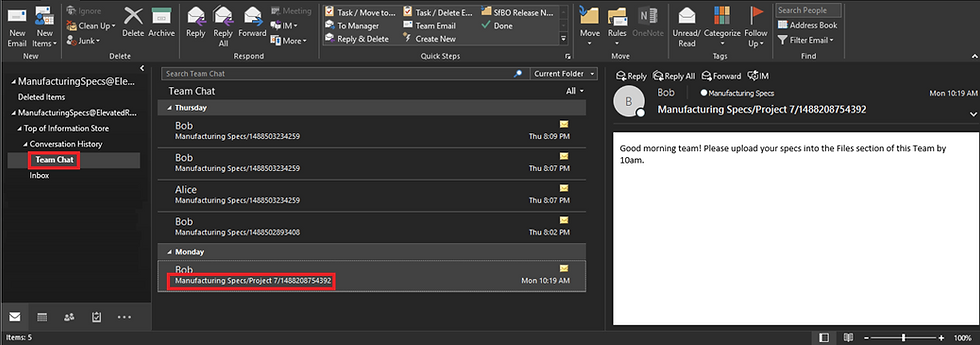
Online video conferencing and collaboration software like Zoom and Microsoft Teams have been used widely during the COVID-19 pandemic. Microsoft has posted a guide here, which describes how to conduct electronic discovery with data from Microsoft Teams. Make note of the following key points:

- Teams chat messages are journaled with users' Outlook mailboxes, so a shadow copy of these messages is included when one is prepared of email messages and other Outlook data.

- The Microsoft eDiscovery tool does not work for all Teams content. Audio recordings and 'like' reactions are not collected.

- Messages from a private channel will be recorded with the individual mailboxes of participants rather than a group mailbox.

- Individual channels within a team cannot be searched separately.

- Teams content can be captured for specific custodians -

- A hold can be placed on Teams content. These holds can be for specific keywords or date ranges.

- A query of Teams data includes statistics on the location of the data, and the keywords that are the most responsive.

- A review set will include .msg files for Teams content.

- When collecting Teams messages, additional messages can be added to those which match the terms in a query to add further context. A setting enables messages sent within four hours of one another to be collected.


Structured is data that is contained in a field for a particular record - such as data in a spreadsheet or a relational database. Unstructured data. Most data is unstructured - electronic files, metadata, web pages.

Semi-structured data is data that is not organized in a relational database, but which contains tags that separate elements of the data. An object database uses semi-structured data. It does not use tables, but instead creates relationships between two data sets directly. Many-to-many relations are established, rather than one-to-many as in relational databases. Object databases work better with complex data.

JSON, email, electronic data interchange (EDI) files, and .xml files are examples of semi-structured files. A .xml file for the contents of a Word document uses hundreds of tags for character formatting, footnotes, etc. - which are nested together in different levels. A .docx file consists of XML files inside a ZIP archive.


Sean O'Shea has more than 20 years of experience in the litigation support field with major law firms in New York and San Francisco.   He is an ACEDS Certified eDiscovery Specialist and a Relativity Certified Administrator.

The views expressed in this blog are those of the owner and do not reflect the views or opinions of the owner’s employer.

If you have a question or comment about this blog, please make a submission using the form to the right. 

Your details were sent successfully!

© 2015 by Sean O'Shea . Proudly created with Wix.com

bottom of page