top of page

Everlaws's document review platform is more intuitive and visually appealing than Relativity, and includes several functions which the more widely used platform lacks.


When setting up a search, you not only have the option to include other family members or near duplicates, but you can also exclude certain documents from the groups added to the search term results. A graphic is included to make clear which documents without keyword hits will be added in the results.


As you select the option to include other versions, attachments, duplicates, or members of the same email thread as the documents which match your search criteria, Everlaw will calculate the percentage of additional documents that will be returned.


There's also an option to exclude duplicate documents from the results.


Everlaw's canonical metadata function will standardize entries in similar metadata fields - so entries of custodian names in fields named, 'Custod'; 'Custodian'; 'Doc Cust' will be merged. Users have the option to toggle between the original metadata and the Everlaw version on the layout in the document viewer.


It is also possible to search on any metadata field in the layout for documents which have the same value:


Everlaw also does a good job of tracking links between documents, indicating the 'backlink' for a document, or another document available in the database which contains a OneDrive or Google Vault link to the current document.


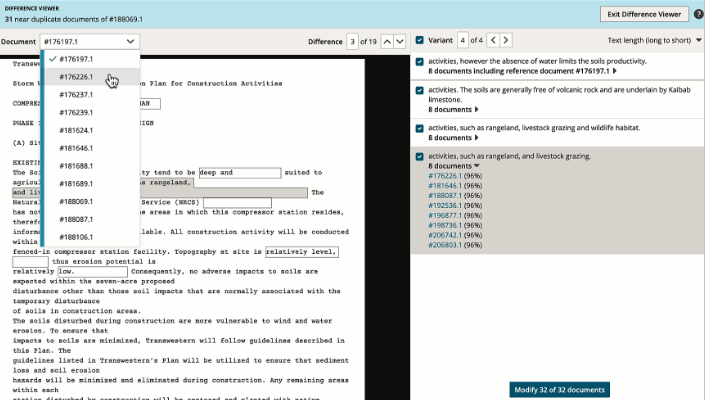
Everlaw's Difference Viewer makes it easy to identify where multiple versions of a single document have been edited. It gives you the ability to scroll through the sections which differ, and then review the variants in the panel to the right.


It's not only becoming common for law firms to submit briefs to courts which they drafted with the assistance of artificial intelligence software, courts are catching them in the act and finding that some of the caselaw cited to in these briefs is completely fictional. AI 'hallucinations' are instances where AI software generates fallacious information in response to a question.


In January, the Second Circuit issued a per curiam decision, Op., Park v. Kim, No. 22-2057 (2d Cir. Jan. 30, 2024), ECF No. 178-1, in which the court found that:


The attorney who filed the brief was referred to the Court's Grievance Panel. The Court cited the 5th Circuit's amendment to its rules which requires that attorneys certify that no generative artificial intelligence was used for a filing, or that at least that the filing was reviewed for accuracy by a human.


In May 2023, Judge Castel of the United States District Court for the Southern District of New York, issued an Order to Show Cause why the plaintiff's counsel should not be sanctioned pursuant to Fed. R. Civ. P. 11 and the Court's inherent authority for submitting an affirmation in opposition to a motion to dismiss which included citations to six "bogus judicial decisions with bogus quotes and bogus internal citations." Order to Show Cause at 1, Mata v. Avianca, Inc., No. 22-cv-1461 (PKC) (S.D.N.Y. May 4, 2023), ECF No. 31. The brief used citations to reporters which actually refer to other cases:


Id. at 2.


Not only did the plaintiff's affirmation refer to Varghese v China South Airlines Ltd., 925 F.3d 1339 (11th Cir. 2019), and other cases which are completely made up, but when the court issued an order asking that plaintiff's counsel submit copies of these cases (Order, Mata v. Avianca, Inc., No. 22-cv-1461 (PKC) (S.D.N.Y. Apr. 11, 2023), ECF No. 25) the counsel in turn filed an affidavit submitting AI generated copies of the imaginary cases! Affidavit, Mata v. Avianca, Inc., No. 22-cv-1461 (PKC) (S.D.N.Y. Apr. 25, 2023), ECF No. 29.


A copy of Varghese was filed on PACER, but it's something that AI simply invented:


PACER doesn't lie!


At a subsequent hearing, Judge Castel excoriated the plaintiff's attorney for submitting the fictitious case:


Hr'g Tr. at 15:17-17:6, Mata v. Avianca, Inc., No. 22-cv-1461 (PKC) (S.D.N.Y. Apr. 11, 2023), ECF No. 52. So the case that ChatGPT invented was not even one which had an internal logic of its own.


The court sanctioned the plaintiff's attorney under Rule 11, fined him $5,000 and ordered him to send a letter to each judge listed as the author of the false cases the affirmation cited to. Mata has been dismissed for being untimely under an international convention that covered a claim for an injury suffered by the plaintiff during an international flight.


This month the S.D.N.Y. dismissed much of the SEC's fraud suit against the software developer SolarWinds Corp. The SAML certificate [which exchanges authentication and authorization data between parties] for SolarWinds' information technology infrastructure platform, Orion, was compromised and malicious actors were able to gain access to the networks of government agencies that used Orion.


The SEC had alleged that SolarWinds failed to disclose information about the SUNBURST cyberattack in 2020 quickly enough. In his decision, Op. & Order, SEC v. SolarWinds Corp., No. 1:23-cv-09518-PAE (S.D.N.Y. July 18, 2024), ECF No. 125, Judge Paul Engelmayer, sustained a claim of fraud based on the SolarWinds Security Statement, but dismissed claims of fraud based on other filings.


In discussing whether or not cybersecurity risk disclosures made in a SolarWinds' SEC filings about its Orion platform used for IT infrastructure were adequate, the Court considered whether or not two previous incidents in which attacks allowed its platform to contact unauthorized external websites meant that it had been subject to a systematic attack. The two incidents were different in that in one Orion was exploited to send data about the network it was installed on, and in the other Orion was used to download malware. Because SolarWinds could not find the root cause of the attacks, and could not be certain that they were associated with one another, it was not required to update its cybersecurity risk disclosure.


To the extent the SEC, in terming the disclosure generic, means to fault Solar Winds for not spelling out these risks in greater detail, the case law does not require more, for example, that the company set out in substantially more specific terms scenarios under which its cybersecurity measures could prove inadequate. As decisions in this District have recognized, the anti-fraud laws do not require cautions to be articulated with maximum specificity. Indeed, these decisions have recognized policy reasons not to require as a matter of law that disclosures be made at the level of specificity known to the issuer. Spelling out a risk with maximal specificity may backfire in various ways, including by arming malevolent actors with information to exploit, or by misleading investors based on the formulation of the disclosure or the disclosure of other risks at a lesser level of specificity.


Id. at 73. (emphasis added).


The Court also rejected the SEC's claim on SolarWinds' post-SUNBURST disclosures. "As to post-SUNBURST disclosures, the Court dismisses all claims. These do not plausibly plead actionable deficiencies in the company's reporting of the cybersecurity hack. They impermissibly rely on hindsight and speculation." Id. at 3. Judge Engelmayer found unpersuasive the SEC's allegation that the failure to state in a Form 8-K filing (made days after the discovery of the SUNBURST breach) that malicious code had been used in the two prior attacks made the filing materially misleading.


Sean O'Shea has more than 20 years of experience in the litigation support field with major law firms in New York and San Francisco.   He is an ACEDS Certified eDiscovery Specialist and a Relativity Certified Administrator.

The views expressed in this blog are those of the owner and do not reflect the views or opinions of the owner’s employer.

If you have a question or comment about this blog, please make a submission using the form to the right. 

Your details were sent successfully!

© 2015 by Sean O'Shea . Proudly created with Wix.com

bottom of page